Training Costs vs. Costs of Poor Competency: Which Is More Expensive for the Company?
October 5, 2026
Industrial companies depend heavily on equipment to maintain daily operations. When equipment stops, productivity can decline quickly.
Equipment age is not always the main cause of operational problems. Technician competency can also influence reliability and maintenance performance.
A competent technician understands systems, evaluates equipment conditions, and performs structured troubleshooting. They can also identify early signs of potential failure.
For this reason, companies should consider technician competency part of their operational improvement strategy.
How Skilled Technicians Reduce Downtime
Downtime occurs when equipment cannot perform its intended function. Its impact can extend beyond maintenance into production and supply chain activities.
Technicians with strong competencies can diagnose problems more systematically. They understand the relationship between symptoms, components, and potential root causes.
Better troubleshooting can reduce the time required to identify technical problems. Technicians can also select corrective actions based on equipment conditions.
These capabilities help companies restore equipment faster. They can also improve equipment availability and operational continuity.
Reducing Rework and Repeated Failures
Incorrect maintenance can allow the same problem to return. This situation forces technicians to repeat the same maintenance activities.
Rework also increases the use of spare parts, tools, labor, and maintenance time.
A skilled technician understands the importance of identifying the root cause. They do not simply repair the visible symptoms.
This approach helps reduce repeated failures. Maintenance teams can also work with more consistent processes.
Making Preventive Maintenance More Effective
Preventive maintenance requires knowledge of equipment and failure mechanisms. Technicians must understand what to inspect and when inspections should occur.
Competent technicians can follow maintenance procedures more consistently. They can also identify abnormal conditions during inspections.
Small findings can provide important information for maintenance planning. Companies can take action before minor issues become major failures.
This approach makes maintenance more proactive instead of reactive.
The Impact on Maintenance Costs
Maintenance costs involve more than spare parts. Companies may also face overtime, emergency repairs, contractor support, and production losses.
Technician competency can help reduce several of these costs. Faster troubleshooting can reduce the time required to resolve technical problems.
Strong preventive maintenance capabilities can also reduce emergency interventions.
Companies may also reduce their dependency on external technical support for certain technical issues.
Skilled Technician and First-Time Fix
First-time fix is an important indicator of maintenance performance. It reflects the ability to resolve a problem without repeated intervention.
Technicians need technical knowledge and practical problem-solving skills to achieve this outcome.
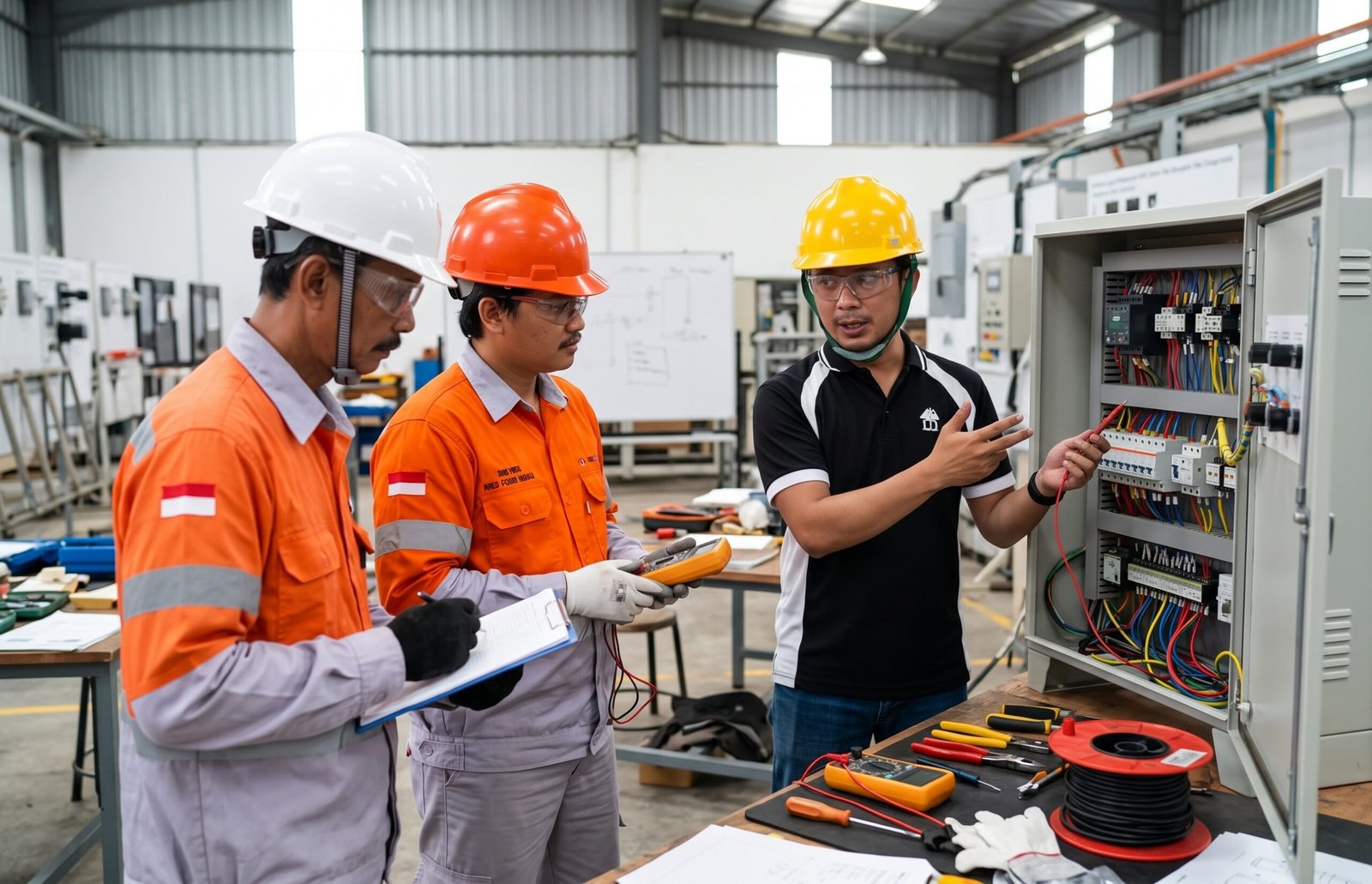
Relevant training can help technicians understand troubleshooting methodologies. They can also develop skills in reading technical drawings and understanding electrical systems.
TSDC uses a practical training approach that connects theory with workshop and workplace application. Its Electrotechnology program was developed with Holmesglen Victoria TAFE and adapted for Indonesian industry needs.
Training Should Match Operational Requirements
Not every technician needs the same training. Each role has different responsibilities and technical requirements.
Companies can begin with a skill gap analysis. Assessment results can then determine training priorities.
Competencies may include electrical troubleshooting, preventive maintenance, motor control, PLC, instrumentation, safety, and technical installation.
This approach makes training investment more relevant. Companies can also connect training outcomes with operational performance.
TSDC combines classroom learning, practical workshops, and workplace application. This model helps participants develop technical competencies through both theory and practice.
Measuring Training Impact Through Operational Metrics
Training should not be measured only by attendance or certificates.
Companies can use operational indicators to evaluate training outcomes. Examples include downtime, MTTR, maintenance costs, equipment availability, and first-time fix rate.
Companies can compare performance before and after training. This data helps Management understand the operational impact of competency development.
A data-driven approach makes technical training more measurable. Training can also become part of a continuous improvement strategy.
TSDC for Technical Workforce Development
Building competent technicians requires structured and practical development programs.
TSDC provides an Electrotechnology Electrician Course based on an Australian apprenticeship curriculum developed with Holmesglen Victoria TAFE.
The program combines classroom learning with practical workshop activities. Participants then apply their competencies through relevant workplace activities.
This approach helps companies develop technical capability over the long term.
A stronger technical workforce can support reliability, productivity, safety, and maintenance performance.
Skilled technician capability goes beyond fixing equipment after a failure. Competent technicians also help prevent problems and improve maintenance efficiency.
Technician competency can influence troubleshooting time, equipment availability, repeated failures, and maintenance costs.
Companies should therefore develop their technical workforce according to operational requirements. The right training can reduce skill gaps and strengthen technical capability.
For companies looking to develop stronger electrical technician competency, TSDC can support technical workforce development. Its programs combine theory, practical workshops, and workplace application to support industrial requirements.
Whatsapp : +62 811 1302 0888
Email ; marketing@ptodg.com