
Before You Commit: What TSDC’s Pre-Assessment Reveals About Your Electrical Workforce
June 2, 2026
Technician Training Is Not a Cost Center: How Does Technical Training Boost Operational Productivity?
August 21, 2026
Modern industries increasingly depend on complex electrical systems.
Production machines, automation, control systems, and utilities require competent technicians.
Technical errors can disrupt production and increase operational risk.
Therefore, companies should treat technician competency as a strategic investment.
It should not become only an HR or training requirement.
Why Is Technician Skill Gap a Business Problem?
A skill gap occurs when technician capabilities do not meet job requirements.
Technology development often makes this gap wider over time.
Industrial automation now involves PLCs, sensors, inverters, drives, and monitoring systems.
Technicians must understand these systems to maintain equipment reliability.
When competency does not develop, troubleshooting can take significantly longer.
Longer troubleshooting directly affects equipment availability and production continuity.
The Impact on Business Productivity
Productivity depends on more than machine capacity.
Technical competency also determines how efficiently equipment operates.
Skilled technicians can identify technical problems faster.
They can also determine corrective actions based on root cause analysis.
Limited competency can create repeated equipment failures.
The same issue may return after maintenance activities.
This situation increases maintenance costs and reduces equipment availability.
For continuous production facilities, the financial impact can become substantial.
Downtime Is More Than a Maintenance Problem
Downtime often appears to be a maintenance issue.
However, its impact can extend across multiple business functions.
When equipment stops, production output decreases.
Production teams may lose working hours and materials.
Companies may also require overtime to recover production targets.
Extended downtime can eventually affect customer delivery schedules.
For this reason, the electrical technician skill gap can become a business issue.
Its impact extends beyond the maintenance department.
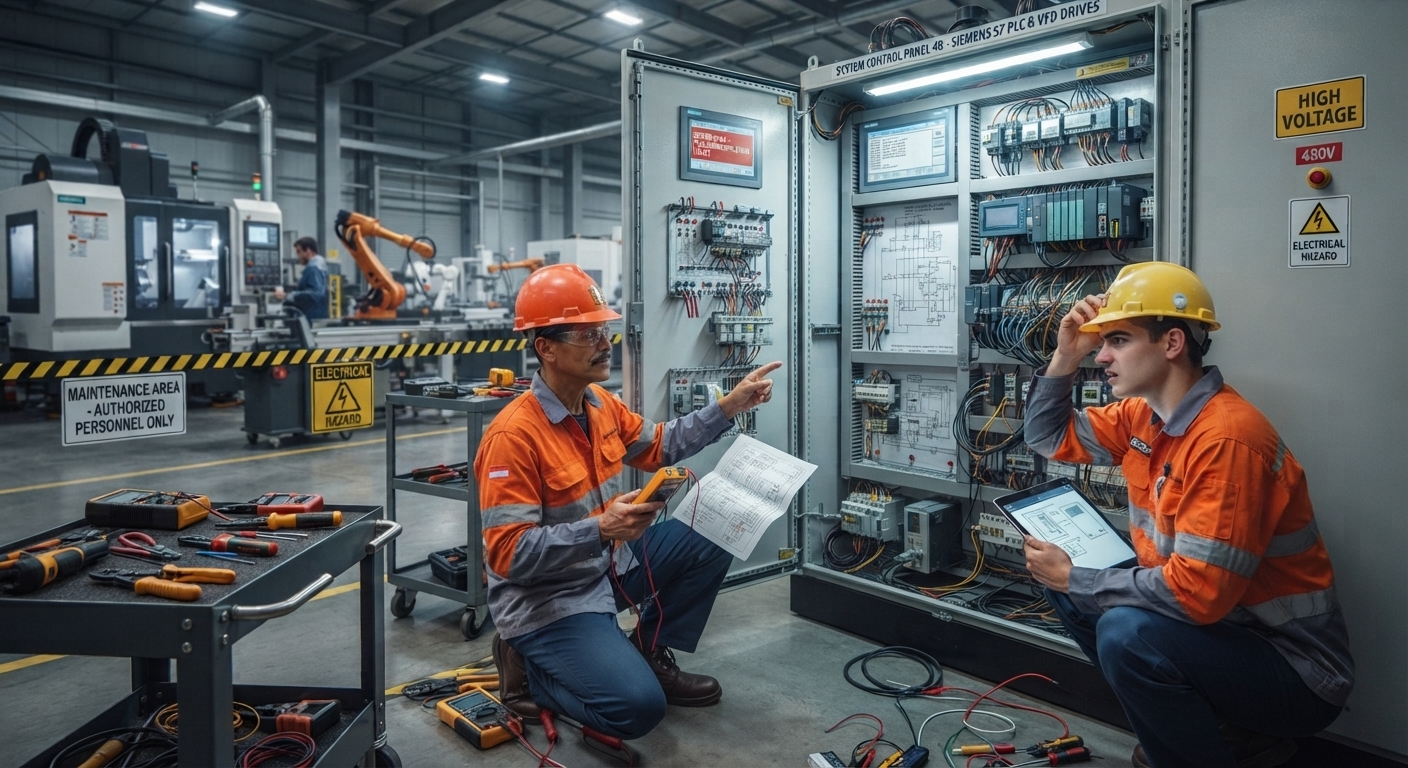
Skill Gap and Operational Risk
Technician competency also influences operational risk.
Electrical systems require strong knowledge of safety procedures and technical standards.
Incorrect diagnosis can cause equipment damage.
Improper installation can also increase the risk of electrical incidents.
Companies need technicians who consistently follow technical procedures.
Training should therefore combine technical knowledge with practical competency.
How Can Companies Measure the Impact?
Companies can use several indicators to evaluate technician competency.
Useful indicators include:
- Mean Time to Repair or MTTR.
- Equipment downtime.
- Repeated equipment failures.
- Maintenance costs.
- First-time fix rate.
- Production losses from technical failures.
- Technical incidents.
- Competency assessment results.
These metrics help management connect technician competency with business performance.
Training Should Reflect Real Industrial Conditions
Technician training should not focus only on classroom theory.
Programs should include relevant equipment, scenarios, and operational problems.
Practical training allows technicians to experience real workplace conditions.
Assessment should also measure troubleshooting and decision-making capabilities.
This approach makes training more relevant to operational requirements.
Companies can also identify competency gaps more objectively.
Turning Skill Development into Business Investment
Technical development can create broader value for industrial companies.
Improved competency can support reliability, productivity, and workplace safety.
Companies can also reduce dependency on external technical support.
This approach can potentially reduce long-term maintenance expenses.
More importantly, companies can build an internal technical talent pipeline.
Experienced technicians can develop into senior technicians or supervisors.
Managing Technician Competency Strategically
The electrical technician skill gap is not only an HR or L&D concern.
It also affects productivity, reliability, safety, and operational risk.
Companies should measure competency gaps against actual operational requirements.
Training programs can then focus on the most important technical capabilities.
TSDC supports companies through practical technical training programs.
Programs can align with industrial requirements and specific technician responsibilities.
With the right strategy, training can become part of business improvement.
The goal is not only better skills, but stronger operational performance.
Whatsapp : +62 811-8111-3032
Email : marketing@ptodg.com