

Why Indonesia’s Electricity Sector Still Lacks Skilled Workers
March 12, 2026
Still Think Training Is a Cost? Here’s How Technician Training Boosts Profit
April 1, 2026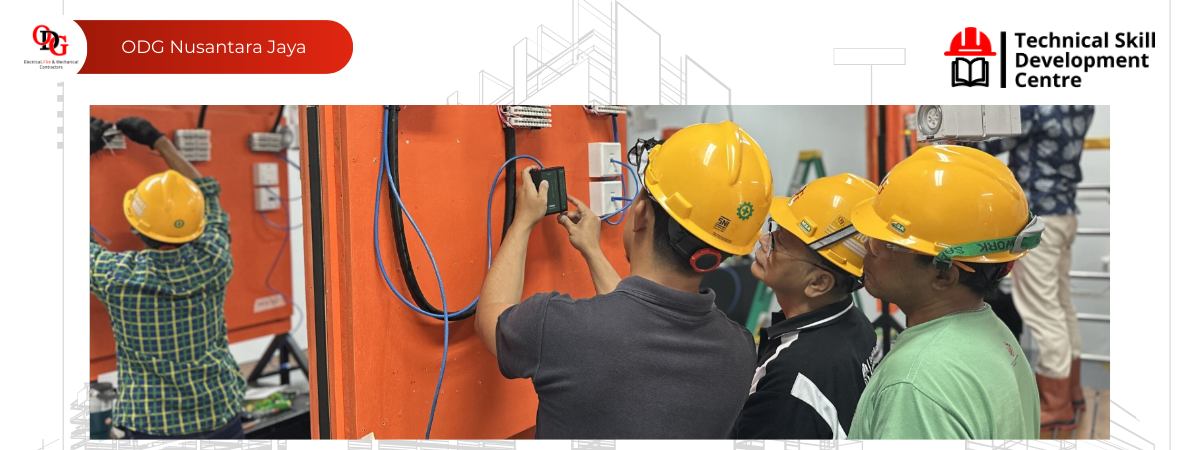
For companies operating in Indonesia’s electrical, construction, energy, or industrial sectors, finding technically reliable electricians has never been straightforward. Certificates are easy to find. Electricians who can work independently, follow proper safety procedures, and perform consistently under real site conditions are considerably harder to come by. This is not simply a recruitment problem. It is a training problem — and it is one that electrical apprenticeship is specifically designed to solve.
Electrical apprenticeship is a learning method that combines classroom education with real-world work experience. Unlike traditional electrical courses that focus mainly on theory, apprenticeship allows participants to gain hands-on experience in actual industrial environments. Participants are not only taught fundamental concepts such as electrical systems and installations but are also involved in real tasks like maintenance, troubleshooting, and system implementation.
This makes electrical apprenticeship one of the most effective forms of electrical training, as it bridges the gap between theory and practice.
For companies, the key distinction is this: the skills being developed are applied directly in your operational environment, on your projects, under your systems. The training is not happening in a generic classroom setting that has little resemblance to your actual worksite. It is happening on your site — verified, documented, and monitored.
Why Electrical Apprenticeship is More Effective
The electrical industry in Indonesia is changing rapidly. Automation systems, renewable energy infrastructure, smart grid technologies, and increasingly complex industrial installations are becoming the norm rather than the exception. The technical demands on electrical workers are higher than they have ever been.
At the same time, the methods most companies use to train their electrical workforce have not evolved at the same pace. The dominant model remains the short course: a few days or weeks of classroom instruction, a certificate upon completion, and an expectation that employees will apply what they have learned independently on the job. According to research , employers prioritize:
-
Willingness to learn; The electrical industry is constantly evolving, especially with the rise of renewable energy, automation systems, and smart grid technologies. Workers are expected to continuously upgrade their skills.
-
Adaptability; Electrical projects often involve unpredictable conditions, such as equipment failures, environmental challenges, or system integration issues.
-
Real work experience; One of the biggest gaps in traditional electrical training and electrical courses is the lack of hands-on experience
-
Multidisciplinary skills; Modern electrical systems are no longer isolated.
Why Electrical Apprenticeship Is More Effective: What Companies Actually See
The advantages of apprenticeship over short-course training are not abstract. They show up in day-to-day operations in ways that HR managers, operations directors, and company owners can observe and measure.
1. Real-World Experience
Apprenticeship participants are not working in simulations. They are handling real electrical systems, real tools, and real installation conditions — in your company’s environment. The skills they develop are immediately applicable to the work your business needs done, because that is the environment in which the skills are being built.
This direct transfer from training to performance is what short courses consistently fail to deliver. A technician who has spent years applying structured learning on actual worksites develops a different quality of competency from one who has attended classroom sessions and returned to work without structured follow-through.
2. Industry Standards Exposure
Electrical apprenticeship programmes that are based on internationally recognised curricula train participants to work according to professional standards — not just the informal habits that can develop when workers learn on the job without structured guidance.
For your company, this matters in multiple ways. It means your electricians understand why safety procedures exist, not just what they are — making them more likely to apply those procedures consistently, even under pressure. It means their installations meet professional quality benchmarks. And it means your company is building a workforce that is aligned with the standards that regulators, clients, and project partners increasingly expect.
3. Soft Skills Development
Beyond technical capability, apprenticeship develops the professional behaviours that make electrical workers genuinely effective in a team environment: communication, problem-solving, adaptability, and the ability to work systematically under pressure.
These are the qualities that separate a technically adequate electrician from one who adds real value to a team. They cannot be taught in a short course. They develop through years of structured, supervised experience in real working conditions — which is precisely what a well-designed electrical apprenticeship provides.
4. Job Readiness
One of the most tangible benefits for companies is that apprenticeship-trained electricians require significantly less ongoing supervision once the programme is complete. They have spent years being observed, corrected, and developed. They have built professional habits that are now second nature. They can be trusted to work independently on complex tasks — which frees your senior technical staff to focus on the work that genuinely requires their expertise.
Solving Industry Challenges
The biggest issue in Indonesia’s electrical sector is the skills mismatch .
Apprenticeship solves this by:
-
Connecting education with industry
-
Providing real work exposure
-
Aligning skills with market demand
TSDC Approach to Electrical Training
TSDC (Technical Skill Development Centre) offers a unique learning approach compared to traditional electrical courses. Our program is designed as a 3-year electrical apprenticeship, where participants develop specific skill sets every 6 months. Each cycle consists of 1 month of intensive classroom learning and 5 months of on-the-job training, allowing participants to work directly in real industrial environments. This ensures not only theoretical understanding but also hands-on experience aligned with industry needs. The TSDC Electrotechnology Apprenticeship Program uses an industry-based curriculum developed in collaboration with Holmesglen Victoria TAFE and tailored to the needs of Indonesia’s workforce. Participants attend classrooms and practical workshops at TSDC, where theoretical knowledge is applied through hands-on training and industry-standard installation practices.
The acquired competencies are subsequently applied in the participants’ respective workplaces, with implementation and progress monitored by their supervisors.
This model is highly effective for companies looking to upskill their workforce through practical electrical training programs.
Let’s build a safer and more competent workforce together.