The Long-Term Value of Completing an Electrical Apprenticeship
April 8, 2026
Want to Become a Certified Professional Electrical Technician? Start Here
April 30, 2026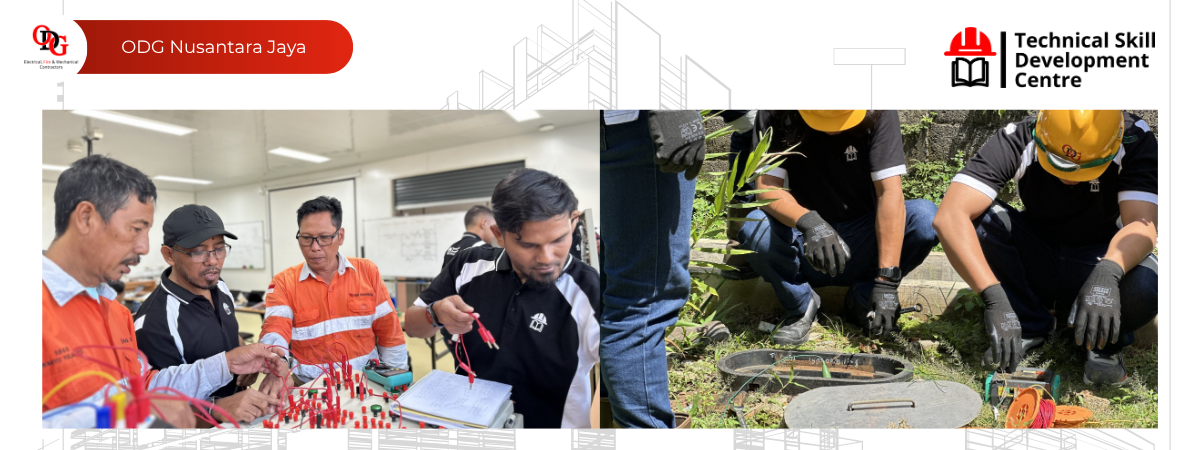
In a recent training session at TSDC, participants worked through motor control wiring — one of the most practical and widely applicable skill areas in industrial electrical work. Motor control systems are everywhere: in manufacturing equipment, pumping systems, HVAC installations, conveyor lines, and industrial machinery across every sector that relies on electrical infrastructure.
The session was conducted using a 40V AC system — a deliberate and considered design choice. By working at low voltage, participants are able to build genuine hands-on confidence in wiring motor control circuits without the risks associated with high-voltage systems. They learn the correct procedures, develop the right habits, and internalise the proper technique — in conditions that allow for learning, correction, and repetition without putting anyone at risk.
This is not a shortcut. It is a pedagogically sound approach to building competency progressively. The goal is not to simulate real work — it is to develop real skill in a controlled environment, so that when participants return to their worksites and work with live industrial systems, their technique is already established and their confidence is grounded in actual experience.
View this post on Instagram
Alongside motor control wiring, the session covered electrical grounding — moving participants outside the classroom for hands-on practice in real grounding installation. Grounding is one of those foundational elements of electrical work that is easy to overlook in theory-based training, yet absolutely critical in practice. A poorly grounded system is a safety liability, a source of equipment damage, and a compliance failure waiting to happen.
Why Grounding Is Not Optional — and Why It Takes Practice to Get Right
Proper electrical grounding is one of the most important technical skills an electrician can develop — and one of the most commonly underdeveloped in workforces that have been trained primarily through short courses or informal on-the-job learning.
TSDC’s training references both PUIL 2020 — Indonesia’s national electrical installation standard — and AS/NZS 3000:2018, the Australian and New Zealand wiring standard that underpins TSDC’s curriculum developed with Holmesglen Victoria TAFE Institute. Both standards converge on the same fundamental requirement: a properly grounded electrical system is a safer electrical system, for the people who install it, the people who work near it, and the equipment it powers.
Teaching grounding to this dual-standard level matters for companies operating in Indonesia’s industrial and infrastructure sectors. It means your employees are not just meeting a local minimum requirement — they are being trained to a standard that reflects international best practice. That has direct implications for the quality and compliance of the electrical work your business delivers.
When grounding is done incorrectly, the consequences are not always immediately visible. Equipment may function normally for months before a fault surfaces. But when it does — through equipment failure, electrical shock, or a fire event — the cost to your business is significant: in downtime, in repairs, in regulatory exposure, and in the human impact on your workforce. Training that addresses grounding properly, with hands-on practice and standards-based instruction, is one of the most direct ways to reduce that risk.
TSDC Approach to Electrical Training
TSDC (Technical Skill Development Centre) offers a unique learning approach compared to traditional electrical courses. Our program is designed as a 3-year electrical apprenticeship, where participants develop specific skill sets every 6 months. Each cycle consists of 1 month of intensive classroom learning and 5 months of on-the-job training, allowing participants to work directly in real industrial environments. This ensures not only theoretical understanding but also hands-on experience aligned with industry needs. The TSDC Electrotechnology Apprenticeship Program uses an industry-based curriculum developed in collaboration with Holmesglen Victoria TAFE and tailored to the needs of Indonesia’s workforce. Participants attend classrooms and practical workshops at TSDC, where theoretical knowledge is applied through hands-on training and industry-standard installation practices.
The acquired competencies are subsequently applied in the participants’ respective workplaces, with implementation and progress monitored by their supervisors.
This model is highly effective for companies looking to upskill their workforce through practical electrical training programs.
Let’s build a safer and more competent workforce together.